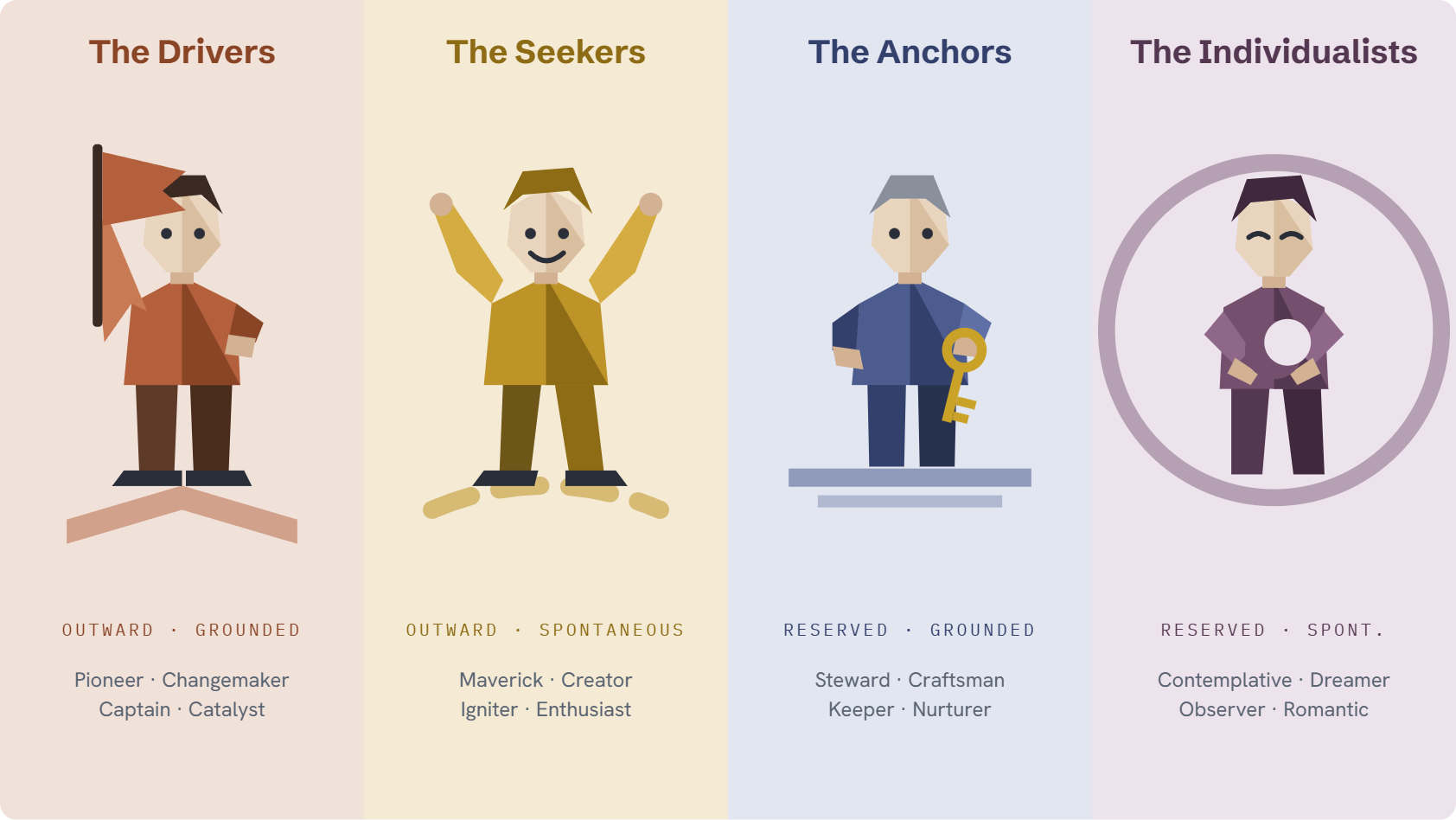
Your archetype is a label built on top of your Big Five scores — not a separate test, not a separate theory. It’s there to make your result easier to remember and share. Your five trait scores and thirty facet scores are still the real result. The archetype is a convenient name for a region of that data, nothing more.
We built it this way on purpose, and it’s worth explaining exactly how, so it’s clear what the archetype is — and what it isn’t.
The two axes it’s built from
Your 16 archetypes come from two broader dimensions, called metatraits. Metatraits aren’t something we invented — they’re a published pattern in personality research. When researchers examine how the Big Five traits correlate with one another, two consistent higher-order factors keep emerging: one combining Conscientiousness, Agreeableness, and low Neuroticism; the other combining Extraversion and Openness.[1] This structure has been replicated and studied under different names — Alpha and Beta, or Stability and Plasticity.[2]
We call our two axes Exploration and Structure:
- Exploration = the average of Extraversion and Openness. How much you reach outward toward novelty, ideas, and people.
- Structure = the average of Conscientiousness, Agreeableness, and reversed Neuroticism. How much you seek order, steadiness, and harmony.
Each axis is scored High or Low, which gives four combinations. Those four combinations are your family.
The four families
From there, two more comparisons narrow the family down to one of four specific archetypes inside it:
- Whether your Openness or Extraversion score is higher (this decides if you’re more ideas-led or people-led)
- Whether your Conscientiousness or Agreeableness score is higher (this decides if you’re more structure-led or warmth-led)
Four families × four archetypes each = 16 total. Every archetype is a specific combination of where you land on those two axes and those two comparisons — nothing about it is arbitrary or hand-picked.
Why it’s not a “type” the way MBTI is
MBTI sorts you into one of 16 types using hard either/or cutoffs. If you’re one point on either side of the midline, you get a completely different letter — even though the underlying trait didn’t meaningfully change.
We don’t do that. Any score close to a dividing line is reported as a blend rather than forced into one box. If your Exploration and Structure scores put you near the edge of two archetypes, you’ll see both — something like “72% Pioneer, 24% Captain” — instead of an artificial full commitment to one label. Someone dead-center between two or more archetypes is told exactly that.
This matters because it’s the honest reflection of what continuous data actually looks like. Most people aren’t purely one thing. The blend is the feature, not a caveat.
What the archetype is for
It’s a shareable, memorable surface sitting atop a much more detailed dimensional profile — useful for talking about your result, seeing it at a glance, or exploring how you compare to others. It is not a diagnosis, not a scientific claim on its own, and not something we’d ask you to make a decision based on without looking at the actual trait and facet scores underneath it.
References
- 1.Digman, J. M. (1997). Higher-order factors of the Big Five. Journal of Personality and Social Psychology, 73(6), 1246–1256.
- 2.DeYoung, C. G., Peterson, J. B., & Higgins, D. M. (2002). Higher-order factors of the Big Five predict conformity: Are there neuroses of health? Personality and Individual Differences, 33(4), 533–552.